A Film Location or a Built Set: Two Kinds of Screen Place
Film location or built set: see how each shapes a story’s sense of place, from weathered surfaces and chance details to carefully controlled space.
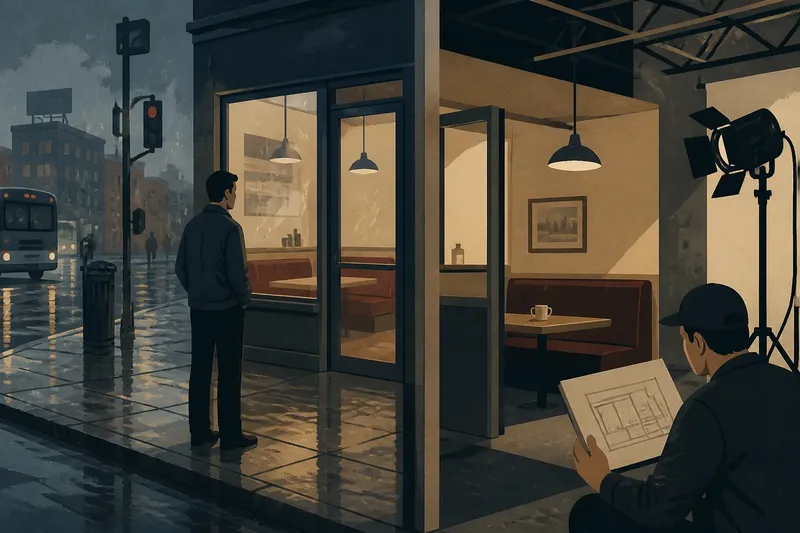
A rain-darkened curb can make a street feel lived in before an actor says a word. On a soundstage, a painted curb and a wet-down hose can give a scene a different kind of precision. A film location or built set does more than provide a background: each makes particular details available to the story, and leaves others out.
Details the place supplies
A real location arrives with marks that were not designed for the scene. Brick varies from one wall to the next. A shop window holds reflections from across the street. The slope of a sidewalk changes how a character walks. These details can lend a scene a sense that life continues beyond the frame.
That abundance is useful when a story needs a place to feel encountered rather than composed. A neighborhood corner, for instance, might carry mismatched signs, old paint, and a bus stop that sits slightly off the imagined center of the shot. Even when the camera selects only a narrow view, the location’s surrounding textures can suggest a larger world.
The same abundance can pull attention away from the intended action. A bright sign may compete with a face; a modern fixture may jar against a period setting. The question is not whether a location is authentic in the abstract. It is whether its specific visible details support the scene’s point of view.
Details the set controls
A constructed set begins with selection. The art department can decide where a doorway sits, what a table holds, and which surface catches the light. This control makes it easier to build a room around the scene’s dramatic needs. A narrow kitchen can keep two characters close; a long corridor can make a pause feel exposed.
Control also lets designers repeat a detail with intention. A chipped mug can sit beside the sink in one scene and return later in the same position. A window can frame a view that matches the story’s mood rather than whatever happens to lie outside the stage. Such choices make the environment legible: the viewer can notice a meaningful object without searching through unrelated clutter.
A set’s precision need not make it feel artificial. Materials, wear, and small inconsistencies help it read as a place rather than a display. A newly built room may need scuffed paint near the handle, uneven objects on a shelf, or a curtain that hangs imperfectly. The point is not to add random mess. It is to choose the traces of use that fit the people who inhabit the room.
Scale and movement
Locations give performers and cameras real distances to cross. A character can approach a distant doorway, move around a parked car, or appear small against an open stretch of pavement. The space provides physical relationships that are hard to suggest with a close view alone.
Yet a real place may limit where a camera can stand or how a scene can unfold. Narrow access, passing pedestrians, or a ceiling that blocks overhead equipment can shape the available coverage. A set can be arranged around movement instead. Walls may be removable, a hallway may be extended, or the room’s layout may be adjusted to keep an important gesture visible.
Imagine a scene in which a character waits outside a closed diner after a difficult conversation. On location, the glass door might reflect passing headlights and show a few tables inside, giving the wait a public, exposed feeling. On a set, the doorway, reflections, and interior can be arranged so the character’s face remains clear and the empty booth becomes a deliberate visual detail. Both can serve the scene; they emphasize different kinds of information.
Weather, light, and sound
Outdoor locations bring changing conditions into the image. Cloud cover softens a scene; hard sun sharpens shadows; wind moves leaves, hair, and loose paper. These effects can make the environment seem active, not merely present. They can also be difficult to keep consistent across separate shots.
A set can make light easier to shape and repeat. A window can admit controlled illumination, while a practical lamp—a visible light source within the scene—can be positioned to motivate the look of a room. The set also allows a crew to choose what lies beyond the window. A painted backing, a projected image, or a constructed view can provide a designed horizon without relying on a changing exterior.
Sound makes the difference just as perceptible. A location may carry traffic, wind, birds, or the hollow echo of a large room. Those sounds can enrich the sense of place, though they may need to be managed or replaced in the final soundtrack. A stage offers quieter conditions, but the resulting silence may need added room tone and environmental sound so the space does not feel empty.
Choosing the screen place
Start with the detail the audience should notice. If the story depends on accidental-looking surroundings—the uneven pavement, the shop across the street, the distant skyline—a location may offer useful complexity. If the scene depends on a precise sightline, repeated object placement, or a room that can change between moments, a set may offer better control.
Then consider what the camera needs to see and what the scene needs to repeat. A location scout can note possible backgrounds, access, reflections, and sources of noise. A set designer can sketch the camera’s view and mark which walls, openings, and objects must be available. These are different forms of preparation, both centered on the details that will reach the screen.
Some productions combine the two. An exterior may be filmed on a real street, while a doorway or interior is recreated onstage. That arrangement can preserve the scale and texture of the street while giving the scene more control once the characters move inside. The transition works best when the visible materials and light feel related, even if the spaces were made in different places.
- Choose a location when surrounding textures and unplanned variation help establish the scene.
- Choose a set when the camera needs a carefully arranged view or the action needs adaptable space.
- Look at surfaces for marks that suggest use, but remove or disguise details that distract from the story.
- Check the frame for windows, signs, reflections, and background movement that may compete with the action.
- Consider sound and continuity when the scene must be repeated under similar conditions.
Questions about screen places?
Why film on location?
A location offers actual spatial relationships and environmental details that can make a scene feel situated in a wider world. It is especially useful when the story benefits from visible surroundings that would be costly or distracting to recreate.
Why build a set?
A set lets the crew shape layout, surfaces, lighting, and camera access around the scene. It can make a small detail easier to see and a complicated movement easier to stage.
Can a set look lived in?
Yes, if its materials and signs of wear match the people who use the space. A few purposeful traces—handled objects, worn paint, or a crowded shelf—usually tell more than decoration added without a character in mind.
Can a real location feel artificial?
Yes. A location can feel wrong for a story if its visible signs, lighting, or layout contradict the scene’s intended world. Selection and framing matter as much as whether the place is real.
The useful distinction is not real versus fake, but which details the scene needs to make visible. A location brings a world with it; a set gives the crew room to compose one. When choosing between them, identify the detail that should stay with the viewer, then ask which kind of place can support it without asking the rest of the scene to compete.