A Post-Show Conversation with One Good Question
A post-show conversation can feel easier with one vivid moment to discuss. Try open prompts, make room for different readings, and let people pass.
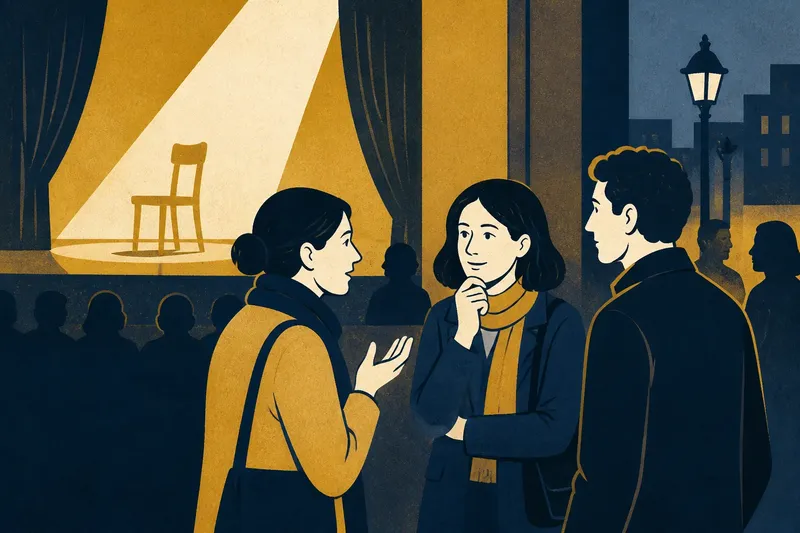
At the theater doors, coats rustle as a friend asks, “So, did you like it?” A post-show conversation can start somewhere more specific: choose one moment and ask what stayed with you. A single image, sound, or pause gives people a place to begin without asking anyone to deliver a verdict.
Pick a small moment
Keep the subject manageable. It might be a prop left onstage, a shift in lighting, a line delivered quietly, or a silence that seemed to stretch. A whole production invites broad judgments; one moment makes it easier to recall what each person actually noticed.
Try an open prompt such as “Which moment stayed with you?” or “What did you notice when the music stopped?” These questions point toward a memory without implying that there is a right answer. “What was the show about?” may feel like a request to explain the production rather than share a response.
Choose a setting that suits the group. A quiet café table can hold a longer exchange. On a crowded sidewalk, trade a sentence each or save the conversation for a text later. The setting does not have to become a formal discussion space.
Match the group
With one companion
Take turns naming a moment before responding. That gives both people room to bring their own memories, rather than letting the first response set the topic. Then ask what each person noticed that the other did not.
Say you and a friend leave a dance performance remembering the same still pose. You recall it as tense; your friend remembers a feeling of calm. You each name the detail that shaped your response—the held posture or the quiet around it—and agree that the moment landed differently for you. The result is a conversation about the performance, not a contest over whose reaction is correct.
With a group
Offer one prompt to the group and invite each person to answer briefly, with the option to pass. A kitchen table or a quiet corner of a café can make a longer exchange comfortable. If people are standing in a busy lobby, ask for one moment each and leave the rest for another time.
If one person is doing most of the talking, suggest a short round in which everyone can share or pass. Do not require a rating or ask each person to name a “best” moment. A pass is a complete response, not a failure to join in.
With different levels of experience
Keep specialist vocabulary optional. Ask what people saw or heard before asking what a choice might mean. Someone new to opera, comedy, or dance can still describe a sudden silence, a costume detail, or a joke that seemed to change the room.
If someone uses an unfamiliar term, invite a simple explanation without turning the exchange into a test of expertise. The aim is to share attention, not to prove who knows the most about the form.
Build an open prompt
A useful prompt names a part of the performance while leaving its meaning unsettled. “What changed for you during that scene?” invites a personal response. “Why was the ending confusing?” assumes the group found it confusing before anyone has had a chance to answer.
Choose a prompt that fits what people remember:
- Memory: If someone recalls a particular image or sound, ask what made it stick; if no one has one in mind, move to a question about a change in the scene.
- Change: If someone noticed their view of a character shift, ask which moment prompted it; if not, ask about a performer’s movement or delivery.
- Attention: If a detail emerged only after another person mentioned it, ask how it changes the scene for you; if nothing new comes to mind, leave the prompt aside.
- Meaning: If a gesture seems open to interpretation, ask what else it might suggest; if the group prefers not to interpret it, stay with what people saw or heard.
- Feeling: If someone describes a change in mood, ask which moment brought it on; if no change stands out, ask what feeling the performance left behind.
- Sound: If a line, song, or pause is easy to recall, ask what its sound contributed; if sound is not what people remember, return to an image or movement.
Ask one question, then give people time to think. A pause may mean someone is searching for a memory. If the talk drifts into a plot recap, return gently to the chosen moment: “What did you notice when that happened?”
Keep readings distinct
Describe the moment before assigning it a meaning. “The actor turned away before the line ended” names a visible action. “The character felt ashamed” is one interpretation of that action. Both can be useful, but making the difference clear leaves room for another reading.
Ask about the detail behind an interpretation in a curious tone: “What made that feel like grief to you?” This invites someone to describe a voice, movement, or pause. A challenge such as “How do you know?” can sound as if the person has to defend a private response.
Uncertainty is a valid place to stop. Someone might say, “I’m not sure what the empty chair meant, but I kept looking at it.” No one has to decode every image before the group can discuss what caught their attention.
Keep criticism focused on the moment rather than the people who liked or disliked it. “I didn’t connect with that scene” describes one response. “Anyone who liked it missed the point” dismisses other people instead of opening a conversation.
What if reactions differ?
What if nobody recalls the same moment?
Let each person name a moment, then choose one to discuss or compare two briefly. If no shared choice emerges, follow the moment that prompts the most curiosity. Different memories do not need to be reconciled.
What if someone gives a harsh verdict?
Ask which moment led to that response, then let someone else describe a different effect. This makes the discussion more specific without requiring anyone to pretend to like the performance.
What if someone sees another meaning?
Ask what detail led them there, then let the reading stand alongside the first one. The group can share attention to the same performance without reaching one agreed interpretation.
What if people are ready to leave?
Offer a single-sentence response or the option to pass, then stop. If someone wants to continue later, they can send a text or bring up the moment another day. The conversation does not need to feel complete before people go.
Leave the talk open
When attention fades, close with a question such as “What are you still wondering about?” It gives people a way to carry an image, disagreement, or unanswered question home without turning the performance into a score.
If a program note or lobby display changes how someone remembers a moment, treat it as additional context, not the final word. A post-show conversation works best when one good question gives everyone room to say what they noticed, what they felt, and what remains uncertain.