How to Read a Press Kit Without Mistaking Promotion for Context
Learn how to read a press kit, trace its credits and materials, and use its information without letting promotional framing shape your account.
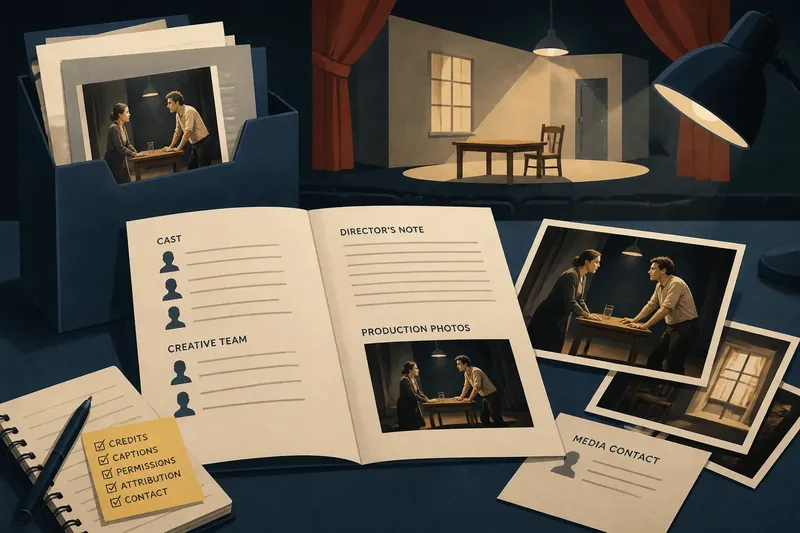
You open a theater’s press kit and find a cast list, a director’s note, and a link to download production photos. Each item has a different job. Knowing how to read a press kit helps you use those materials without turning them into a ready-made story about the production.
Press kit basics
A press kit, also called a media pack, collects information and assets for people covering or presenting a production. For a film, theater show, or television series, it might contain a synopsis, cast and crew biographies, production notes, approved images, credits, and contact details.
These materials are assembled for public use. That purpose affects what appears and how it is arranged. A short synopsis favors a concise premise; a biography may highlight experience relevant to the project. Those choices do not make the material useless. They tell you what each part is designed to communicate.
Start by identifying the item in front of you. A credit list names roles. A production note describes what a maker says they intended. A photo shows a particular frame or moment. Keeping these forms separate makes it easier to use each for its proper purpose.
Follow the document trail
Press kits are often distributed as PDFs or web pages, with images stored in a separate download folder. Save the original file and note its publication date or version if one is provided. This helps you distinguish a later update from an earlier copy when credits or contact details change.
For a quick first pass, check these concrete points:
- Title and version: If the kit names a production title and version, use that wording; if versions are unclear, check the production’s official page before identifying it.
- Credits: If a person’s name and role appear together, preserve that pairing; if the role is missing, do not infer it from the biography.
- Image captions: If a caption identifies a performer or scene, use only that stated identification; if it gives no scene details, describe only what is visibly present.
- Image permissions: If the kit states usage terms, follow them; if terms are absent or unclear, contact the listed publicity representative before publishing the image.
- Production notes: If a note attributes an aim to a maker, identify it as a stated intention; if no speaker is named, attribute it to the kit rather than to an individual.
- Contact details: If a press contact is listed, use it for unresolved production questions; if the contact is missing, look for an official production or venue page instead.
These checks also help you keep a record of where a detail came from. That can be useful when a kit combines text, captions, and files that do not all carry the same information.
Use each asset well
A synopsis is a compact account of a premise, not a full description of the plot or structure. When it uses words such as “bold” or “moving,” those are promotional judgments. For a factual description, focus on concrete details the synopsis supplies, such as the named characters, setting, or source material.
Production notes can explain a maker’s stated aims, references, or working choices. Treat them as attributed comments, not as a verdict on how the finished production comes across. A note about a costume designer’s inspiration, for instance, can tell you what the designer says informed the work; it does not establish what every audience member will notice.
Images have their own practical limits. A caption may identify a performer, photographer, or scene, while a photo itself can show visible details such as clothing, lighting, or arrangement. Avoid using an image alone to describe the full production, and check its credit and usage terms before publication.
Say you are writing a preview of an invented touring play. The kit lists a director and a lighting designer, includes a captioned photo of two performers beside a table, and says the director wanted the room to feel tense. You record the two credited roles, describe the visible table and performers, and attribute the stated aim to the director. The result is a preview that uses the kit’s information while leaving your own account of the performance for after you see it.
Check names and roles
Credit blocks can be hard to scan, especially when a production has several versions or many collaborators. Copy names carefully, preserve accents and other marks, and keep each role attached to the person named beside it. “Written by,” “directed by,” and “designed by” refer to different contributions; one title should not be used as a shortcut for who made every part of the work.
If a detail matters to your account, compare it with an official production page, venue listing, or fuller credit list. If those sources differ, check with the production’s press contact. When a discrepancy cannot be resolved, attribute the wording to the document you consulted or leave the uncertain detail out.
Questions about press kits?
Who uses a press kit?
Journalists, broadcasters, venues, and presenters use kits to locate concise production information and approved materials. Audience members can read them too, keeping in mind that the materials are prepared for public presentation.
Does a press kit replace a review?
No. A kit supplies information and the production’s own framing; a review gives a critic’s response to the work. Use the kit for details such as credited roles, not as a substitute for seeing or assessing the production.
Can I publish a press photo?
That depends on the image’s usage terms and the publication’s needs. Check the kit’s permission language, retain the required credit, and ask the press contact if the terms are not clear.
What if a detail is missing?
Check an official production page or contact the listed representative. If the information remains unavailable, state only what the kit provides rather than filling the gap with a guess.
Keep the source visible
When you use a press kit, record whether a detail came from a credit, a caption, a production note, or promotional copy. That small habit makes attribution clearer and keeps a publicity document in its proper role: a useful source for the production’s public-facing materials, not a replacement for your own description or judgment. When a specific claim matters, preserve the source wording and the name of the person or document attached to it.